QR code/QR codes, 2D codes, GS1 Digital Link, GS1 Sunrise, application identifiers, code quality
Is your brand looking to adopt 2D codes for the GS1® Sunrise 2027 initiative?2D codes offer advantages over 1D EAN/UPC barcodes for containing variable data such as batch/lot numbers and date codes. To realize the most benefits that 2D codes can bring to brand owners, they will need to be printed inline rather than pre-printed. As a result, the responsibility for high-quality codes shifts from the material supplier to your packaging team.
The good news is that, if you have already invested in advanced coding equipment, you might be well-equipped to face these challenges.
There are several important factors to consider when getting ready to print 2D codes powered by GS1 Digital Link on your packaging lines:
Make sure your print technology is well-matched to your application and production requirements.
Ensure that the data you encode in the 2D codes matches the GS1 specification.
Verify that your printed 2D codes meet or exceed the required quality level.
The GS1 Sunrise 2027 initiative demands that printed 2D codes remain scannable from production to point-of-sale (PoS). Excellent print quality and durability, precise data accuracy, and consistent code reliability are crucial.
What are the right Application Identifiers for 2D codes?
As part of the GS1 Sunrise 2027 initiative, 2D codes powered by GS1 Digital Link encode data utilizing GS1 Application Identifiers (AIs). An excellent source of information about AIs is the GS1 2D Barcodes Implementation Guide.
Depending on a brand’s needs, various AIs can be used. Some of the common identifiers employed in retail are:
01 – Global Trade Item Number (GTIN). This is always the 14-digit GTIN
What’s the difference between QR codes® and DataMatrix codes?
QR codes powered by GS1 Digital Link are the key type of 2D codes to use for Sunrise 2027
Although DataMatrix codes could be used, they may not provide the consumer engagement capabilities of QR codes
While both QR codes powered with GS1 Digital Link and DataMatrix codes can contain the same data using GS1 AIs and include a web link (URL), QR codes are a more established way to engage consumers directly with detailed nutrition information, recycling instructions, coupons, and more.
What is the right QR code structure for PoS?
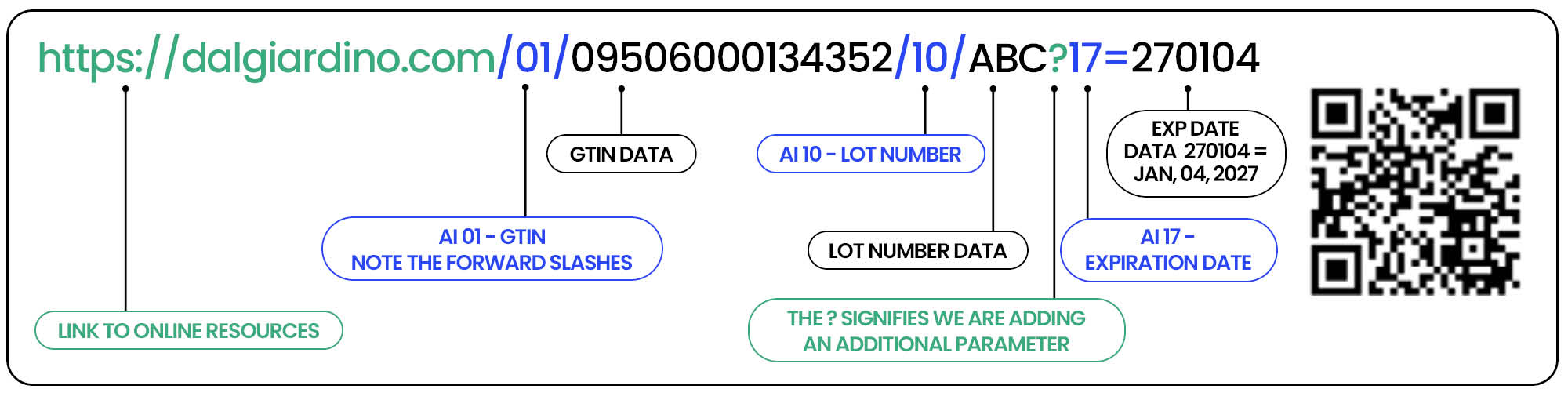
In this example from GS1, a product’s Digital Link structure contains the following data attributes in a QR code:
GTIN: 09506000134352
Lot or Batch Number: ABC
Expiration Date: 270104 – January 4, 2027
QR code powered by GS1 Digital Link
The example code above scans to the GS1 demo for “Dal Giardino” products.
How is 2D code quality controlled?
When you print a 2D code on your packaging, it is vital that every PoS scanner and handheld device used in a retail environment can scan and decode it successfully. To make sure this is achieved, GS1 specifies a particular quality level for 2D codes, as defined in the international standard ISO/IEC 15415.
The GS1 General Specification requires a minimum quality score of 1.5 (or C in the old ANSII grading system). The below example shows the additional criteria for PoS-only codes. For general distribution (such as warehouse management) there are different criteria, including larger x dimensions and larger codes.
Verification is a process of scoring or grading 2D code quality according to ISI 15415 standard or other standards-based grading.
There are several versions of code verifier devices available for 2D codes, including tabletop models for spot-checking codes and inline models that can verify codes on the packaging line.
Verifiers assess several parameters, including symbol contrast, print growth, modulation, and quiet zones, and assign an overall quality grade from 0.0 to 4.0, with 4.0 representing the highest score. A higher grade indicates a code that is more robust through the supply chain and more likely to scan quickly at PoS. Although this numeric scale is the newer way to express quality, many users and grading tools still reference the legacy ANSI A-F grading system method, where a 4.0 corresponds to an A and a 0.0 corresponds to an F.
The verifier produces a results page for each code that it inspects. These results can be saved to show the code quality in the event an issue occurs later.
How is 2D code syntax validated?
Validation is a way to check that the code syntax (URI data construction) conforms to the GS1 Digital Link standard. Until now, this has often been done manually, but increasingly it is controlled at the point of template design. Solutions like Videojet Velicity™ Design include a Digital Link design wizard to help ensure correct QR code syntax. It can then be double-checked inline with camera systems that verify the syntax aligns with the Digital Link structure such as the correct GTIN length, correct YYMMDD date formats for expiration dates, and proper use of application identifiers.
Expert insight: “For GS1 Sunrise, the focus should be on how codes perform in real scanning environments. That means validating syntax at the design stage and verifying print quality against the correct standards for point of sale.”
Which print technology should be used for 2D codes?
The Videojet product portfolio includes a wide range of printing and marking solutions that can produce clear, scannable 2D codes and alphanumeric text on just about every retail packaging type.
Thermal transfer overprinters (TTO): TTO technology is excellent for printing high-quality 2D codes, text, and images on flexible packaging and labels on both continuous and intermittent motion packaging equipment.
With a larger print area than the other coding technologies, TTO is highly versatile in the print formats it can handle.
Laser marking systems: Laser marking systems are designed to operate with minimal maintenance, even in challenging environments. These systems can produce highly detailed and permanent scannable 2D codes and alphanumeric text on a variety of retail packaging materials, including plastic, glass, paperboard, and flexible films. The marks remain intact throughout the distribution process and will not rub off.
Unlike other technologies, lasers do not require ink or ribbon consumables. Since various materials react differently to laser marking, it’s important to have your packaging substrates tested to determine the ideal laser for your application.
Thermal inkjet (TIJ): Offering low maintenance requirements, excellent uptime, and high-resolution printing, TIJ technology, usually with a maximum print height of 12.5mm, can produce 2D codes and alphanumeric codes of exceptional quality on a wide range of packaging materials.
Label print and apply (LPA): LPA systems are commonly used for secondary packaging, such as cases and cartons. These systems can print and apply labels with high‑resolution 2D codes, delivering clear, scannable information for distribution and traceability.
Continuous inkjet (CIJ): These industrial inkjet printers can provide excellent print quality for codes and text on various packaging materials. With fast-drying, highly durable inks, CIJ printers can operate at the high output speeds needed for the most demanding applications.
Work with a Videojet expert to confirm whether CIJ technology meets all your application’s requirements for 2D code quality verification.
In addition, Videojet Velicity™ Design supports label and code compliance by standardizing template creation and management. Centralized control, guided data entry workflows, and barcode design tools help reduce reliance on operator decisions and manual steps that can introduce errors.
Bottom line
It’s crucial to focus on three key factors to successfully implement 2D codes for GS1 Sunrise 2027: code quality, syntax accuracy, and printing technology. Videojet is here to support this transition with expertise and solutions aligned to the Sunrise initiative. Contact us to help guide your packaging operations as they move to 2D codes.